
Tankless Water Heater Service in Pompano Beach, FL
Descaling, repair, and installation for tankless units, which need different maintenance than a tank ever did.
Why tankless units need descaling and a tank never did
A tank water heater sits full of water all the time, so mineral buildup settles to the bottom as sediment and gets flushed out occasionally. A tankless unit heats water on demand as it passes through a narrow heat exchanger, and that's exactly where mineral scale builds up over time in an area with moderately hard water like South Florida.
Left alone, scale buildup shows up as inconsistent water temperature, a drop in flow rate, or the unit's error code for a restricted line. Manufacturers generally recommend descaling every 12 to 18 months in this kind of water, more often than most homeowners expect coming from a tank system. Gas-fired units are vented to the same International Fuel Gas Code standard Florida applies to any gas appliance, which is why venting gets checked alongside the descaling schedule.
What a descaling service actually involves
Descaling flushes a vinegar-based or manufacturer-approved solution through the heat exchanger in a closed loop, using the isolation valves installed with the unit, to dissolve mineral buildup without disassembling the unit itself. If those isolation valves weren't installed originally, adding them is usually the first step before descaling can even happen properly.
For a unit that's already showing error codes or inconsistent temperature, we diagnose whether it's scale, a failed component, or a gas or electrical supply issue before recommending a fix, since not every tankless problem is a descaling problem.
Installation details that get missed on a first-time tankless install
Beyond the unit itself, a correct tankless installation includes isolation valves for future descaling, a properly sized gas line or dedicated electrical circuit depending on fuel type, and venting rated for the unit's output. Retrofitting a home that previously had a tank means checking all three, not assuming the existing setup is already adequate.
Skipping the isolation valves is the single most common shortcut we see on installs done elsewhere, since it turns every future descaling into a bigger job than it needs to be. If a unit already lacks them, adding them is usually worth doing at the same time as the first service rather than waiting.
Multi-unit and larger household setups
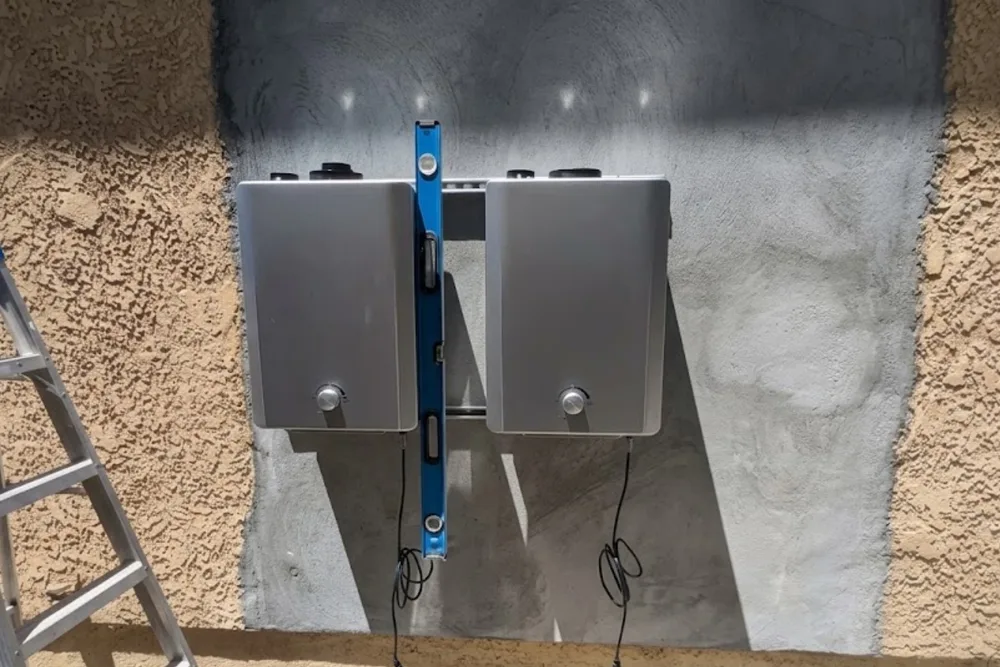
A single tankless unit sized for a smaller household can struggle to keep up when two showers and a dishwasher run at once, which shows up as a temperature dip rather than an outright failure. For larger households, a properly sized single unit or a two-unit setup solves this at installation time rather than after the fact.
Households upgrading from a tank that was already undersized sometimes expect tankless to fix a hot water shortage on its own. It will, but only if the new unit is sized to the home's actual peak demand, which is why we measure fixture count and typical simultaneous usage before recommending a specific model rather than defaulting to a mid-range unit.
What Actually Affects Cost
- Descaling vs a component repair vs full replacement
- Whether isolation valves already exist for descaling
- Unit size relative to household hot water demand
- Gas line or electrical circuit changes for a new install
Most homeowner insurance policies cover a sudden, accidental plumbing failure, a burst pipe, for example, but not gradual wear or a line that failed from ordinary age-related corrosion. That's the honest baseline to plan around rather than assume coverage applies.
Want your real number for this job? Call (954) 697-4920.
Related Services in Pompano Beach
A household considering tankless for the first time should look at water heater installation & replacement to compare against a straightforward tank swap, since tankless isn't the right fit for every home's gas or electrical setup. If hard water is the root issue behind the scale buildup, water softener installation & repair addresses that at the source rather than treating the symptom repeatedly. A unit with a failed component rather than scale buildup is a water heater repair situation instead, and worth a full diagnostic visit rather than a DIY flush attempt.
Tankless Water Heater Service Questions
How often does a tankless water heater need descaling here?
Roughly every 12 to 18 months given the water in this area, though a unit with a whole-home water softener ahead of it can often go longer between services.
My tankless unit is showing an error code. Is that always a descaling issue?
Not always. Error codes can point to scale buildup, a gas or electrical supply problem, or a failed component. We diagnose which one before recommending a fix.
Can any plumber descale a tankless unit, or does it need to be the installer?
It doesn't need to be the original installer. Any technician familiar with the isolation valve setup can perform the service, though if isolation valves were never installed, that gets added first.
Can a tankless unit be added without removing the old tank right away?
Not usually in a single-unit home, since the tankless takes over the tank's role entirely and both aren't typically run side by side. Removal happens as part of the same visit, including draining and disposing of the old tank so nothing is left behind for the homeowner to deal with.