
Tankless vs Tank Water Heaters: What Fits a Florida Home?
Both are solid choices. The right one depends on the home's existing setup, the household's actual hot water usage, and how much upfront cost makes sense.
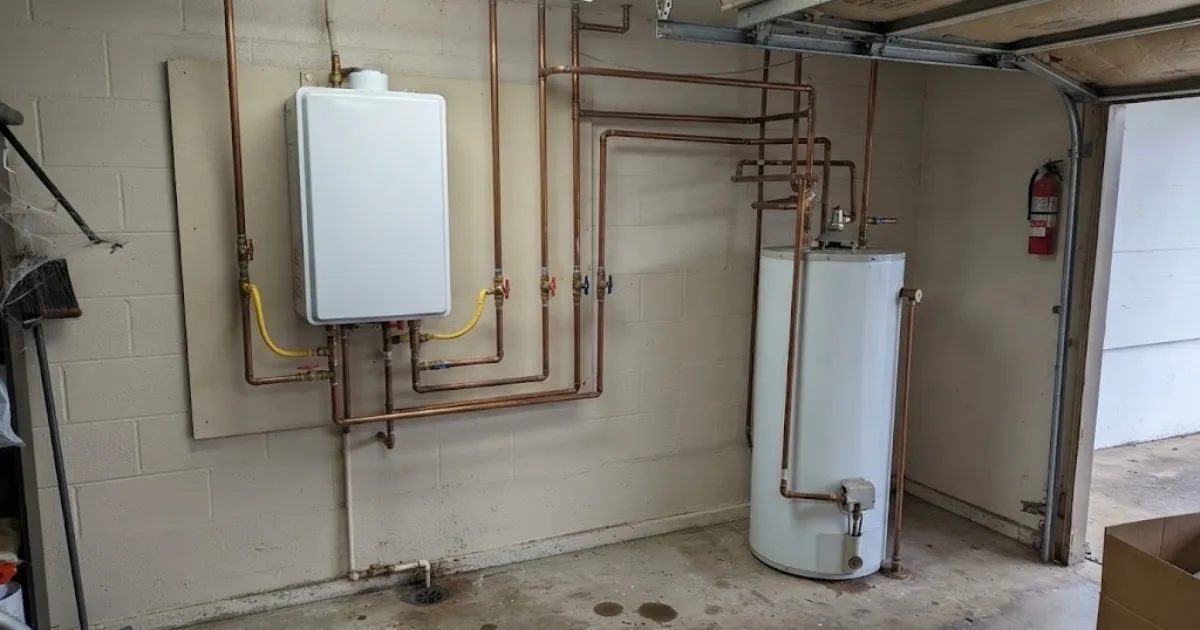
The core difference, beyond the obvious
A tank water heater stores and continuously heats a set volume of water, ready to use but limited to that volume before it runs out and needs to reheat. A tankless unit heats water on demand as it flows through, which means it never technically runs out, but its output rate is limited, so two showers and a dishwasher running simultaneously can still cause a noticeable temperature dip if the unit isn't sized for that demand.
Upfront cost and installation complexity
A tank unit costs less to purchase and is typically a simpler swap when the existing gas or electric hookup already fits. A tankless unit costs more upfront, and installation complexity rises further if the home's gas line needs upsizing or a dedicated electrical circuit needs adding, which happens often enough on an older home that it's worth budgeting for as a real possibility, not an edge case.
Comparing the two side by side
Neither option is a wrong choice on its own. The better fit depends on the household's actual usage pattern and how much the upfront cost difference matters relative to the longer-term maintenance and lifespan differences.
| Factor | Tank | Tankless |
|---|---|---|
| Upfront cost | Lower | Higher |
| Typical lifespan (this area) | 8-12 years | 15-20 years |
| Space needed | More (full tank) | Less (wall-mounted) |
| Hot water limit | Runs out, then reheats | Continuous, rate-limited |
| Maintenance | Annual flush | Descaling every 12-18 months |
Which households tend to prefer each option
A smaller household with straightforward hot water needs, or a homeowner prioritizing the lowest upfront cost, is often better served by a tank unit, especially if the existing hookup already fits. A larger household that regularly runs multiple hot water fixtures at once, or a homeowner planning to stay in the home long enough to benefit from the tankless unit's longer lifespan, often finds the higher upfront cost worthwhile.
What matters most in South Florida specifically
This area's moderately hard water affects both options, shortening a tank's effective life through sediment buildup and requiring more frequent descaling on a tankless unit than the manufacturer's generic recommendation might suggest. Whichever option a household chooses, factoring in that water condition, and considering a water softener alongside either choice, makes a real difference in how long the investment actually lasts.
A note on gas versus electric for either option
Both tank and tankless units come in gas and electric versions, and the choice between fuel types is often driven by what's already available at the property rather than a preference between tank and tankless specifically. A home without existing gas service faces real added cost to run a new gas line just for a water heater, which sometimes tips the decision toward electric regardless of which tank style is otherwise preferred.
Rebates and incentives worth checking before deciding
Utility rebates and, in some cases, federal tax credits are periodically available for high-efficiency water heaters, tankless units in particular, which can meaningfully offset the higher upfront cost. These programs change over time, so checking current utility and federal incentive programs before finalizing a decision is worth the few minutes it takes, since it can shift the cost comparison between tank and tankless in a real way.
Related Reading
For installation specifics on either option, water heater installation & replacement and tankless water heater service both cover the details relevant to each. Coverage extends across Pompano Beach and the surrounding cities on the service area page.
Tankless vs Tank Questions
Is tankless always the better long-term investment?
Often, given the longer lifespan, but only if descaling happens on schedule. A neglected tankless unit can underperform a well-maintained tank unit despite the higher upfront cost.
Can I switch from tank to tankless without major renovation?
Often yes, though it depends on the home's existing gas line size and electrical setup. We assess this during the estimate rather than assuming every home is a simple swap.
Does a water softener help either type last longer?
Yes, for both. Softened water reduces sediment buildup in a tank and scale buildup in a tankless heat exchanger, extending maintenance intervals either way.
Which option is better for a smaller condo or apartment?
Space and existing hookup often decide this more than household size. A smaller space with an existing tank hookup usually favors staying with a tank unless there's a specific reason to switch.
Can a tankless unit be installed outdoors in Florida?
Yes, many tankless units are rated for outdoor installation, which is common in Florida and can simplify venting requirements compared to an indoor installation.
How much smaller is a tankless unit compared to a tank?
A tankless unit typically mounts flat against a wall taking up a fraction of the floor space a standard 40 to 50 gallon tank requires, which matters in a smaller utility closet.
Do tankless units work during a power outage?
A gas tankless unit typically still needs electricity for its ignition and control system, so most units, gas or electric, won't function without power unless paired with a backup power source.
Can a tankless unit serve two bathrooms at once reliably?
Yes, if sized correctly for that demand level. Undersized units are the actual cause of performance complaints, not a fundamental limitation of tankless technology.
Is a permit required to install either type of water heater?
Most jurisdictions require a permit for water heater installation or replacement, which is typically handled as part of the installation process.
Does a tankless unit need more frequent filter changes than a tank?
Tankless units typically have an inlet water filter that needs occasional cleaning, a simple task, while a tank unit has no equivalent filter but benefits from periodic sediment flushing instead.