
How to Tell If Your Home Still Has Galvanized Pipes
A few simple checks can tell you whether a home built before 1980 in this area still has its original galvanized supply lines still in place, before a technician ever even needs to make a visit out to confirm it.
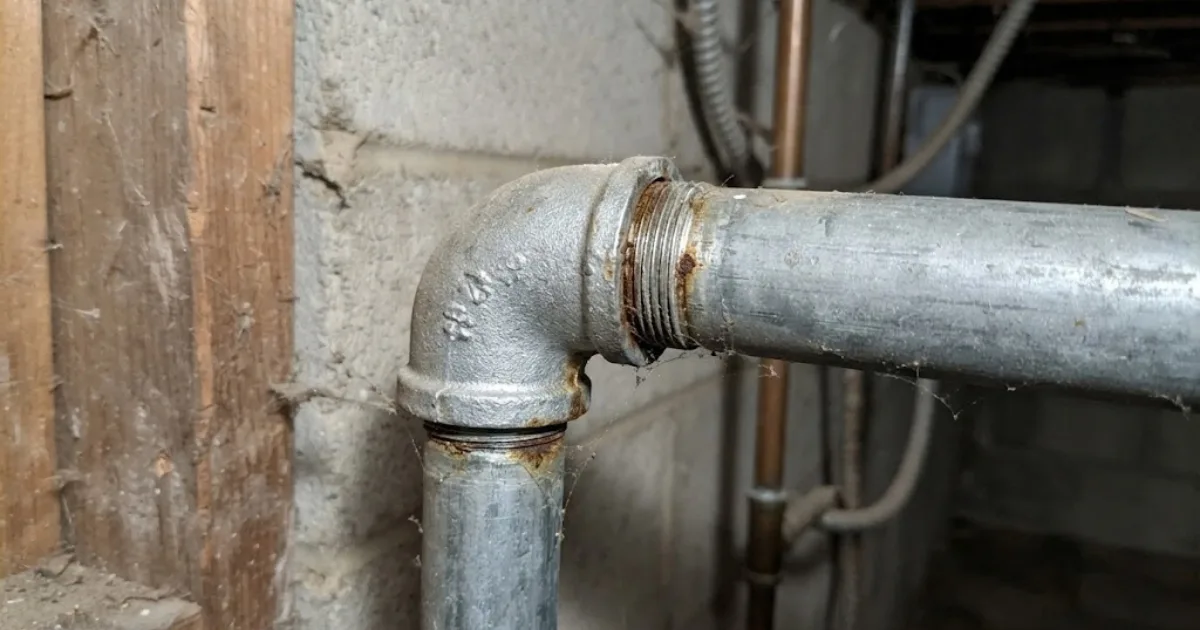
What to do before touching any exposed pipe
Avoid forcefully tapping, scraping, or applying pressure to exposed galvanized pipe when checking it, since heavily corroded pipe can be more fragile than it appears and an accidental impact can trigger a leak on the spot. A visual and magnet check is sufficient. Leave any physical testing to a professional.
Why the build year is the first clue
Galvanized steel pipe was standard for residential supply lines through the 1950s, 60s, and into the 70s, before copper and eventually PEX became the norm. Any home in Pompano Beach or its neighboring coastal cities built before roughly 1980 is a real candidate for still having some or all of its original galvanized supply lines, simply because there was never a mandatory replacement requirement, only repair as issues came up.
A simple visual check anyone can do
Galvanized pipe has a distinctive dull gray color and, unlike copper's smooth surface, often shows visible threading at joints where sections screw together. Check an exposed section near the water heater, in a utility closet, or in a crawlspace or basement area if the home has one. A simple magnet will stick firmly to galvanized steel pipe but not to copper or PEX tubing, which is a quick and easy way to confirm the material without needing to be a plumbing expert at all.
Signs the pipe is failing, beyond just its age
Reduced water pressure that's gotten noticeably worse over time, rather than pressure that's always been low, often means internal corrosion has narrowed the pipe's effective diameter. Rust-colored water, especially right after the water has sat unused for a while, like first thing in the morning, is another common sign specific to galvanized pipe corrosion.
What finding galvanized pipe actually means for a homeowner
It doesn't mean an immediate emergency. Galvanized pipe can function for years even as it slowly corrodes, and plenty of homes with this pipe material have no active problems at all. What it does mean is that the pipe is on a finite, largely unpredictable timeline, and being aware of that timeline helps a homeowner plan a repiping decision proactively rather than reactively after a leak forces the issue.
Getting a professional confirmation
A technician can confirm the pipe material and get a general sense of its condition during a routine visit for any other service, often without any additional cost beyond the visit itself. This is worth asking about specifically if a home's age and the signs above suggest galvanized pipe might still be in place.
What happens if galvanized pipe is left in place indefinitely
Nothing catastrophic happens on a fixed timeline, but the risk profile changes gradually: water pressure continues declining as internal corrosion narrows the pipe further, the odds of a leak developing at any given point in the line increase year over year, and water quality concerns from internal corrosion products become more relevant the longer the pipe stays in service. None of this means immediate action is required, but it does mean the decision gets less optional over time, not more.
How this affects homeowners insurance over time
Some insurers ask directly about plumbing material and age during underwriting or renewal, and a home with known original galvanized pipe can occasionally see this reflected in premiums or coverage terms, though this varies significantly by carrier and isn't universal. Documenting a repiping once it's done is worth keeping on file, since it can be relevant for insurance purposes well beyond the plumbing itself.
Related Reading
For the full picture on replacement options and what a repiping job actually involves, repiping & whole-home pipe replacement covers the process in detail, and leak detection is the right first step if a specific leak is already suspected. Deerfield Beach's mix of older beachside and newer inland housing makes this an especially relevant topic for that city specifically.
Galvanized Pipe Questions
Is galvanized pipe a health hazard?
As it corrodes internally over time, galvanized pipe can leach lead and other materials into the water supply, which is a real health consideration worth taking seriously alongside the leak risk.
Can galvanized pipe be repaired instead of fully replaced?
A single section can sometimes be repaired, but since the whole line corrodes on a similar timeline, a repair often just delays the next issue rather than solving the underlying problem.
Does homeowners insurance care about galvanized pipe?
Some insurers ask about plumbing material and age during underwriting, and older galvanized pipe can occasionally affect coverage terms or premiums, which is worth checking with a specific insurer.
How urgent is replacing galvanized pipe if it's not actively leaking?
Not an emergency if there's no active leak, but worth planning for proactively given the pipe's finite and unpredictable remaining lifespan at this point.
Is there a specific test kit for galvanized pipe?
No consumer test kit reliably confirms pipe material. A visual check for color and threading, combined with a magnet test, plus professional confirmation, is the practical approach.
Does galvanized pipe affect water taste?
As corrosion progresses, some homeowners notice a metallic taste, particularly in water that's sat in the pipes overnight, which is another sign worth mentioning during an inspection.
Can galvanized pipe be identified from outside the home?
Not reliably at all from the outside. Interior exposed sections or a professional inspection are the only truly accurate ways to confirm the actual material, since exterior appearance never reveals interior plumbing.
Does replacing galvanized pipe improve water heater efficiency?
Indirectly, since improved flow and reduced sediment intake can help a water heater operate somewhat more efficiently, though it's not the primary reason to repipe.
Can a home have galvanized supply lines but PVC drain lines?
Yes, this is a common combination in homes from this era, since supply and drain lines don't always get replaced or installed on the same timeline or by the same standard.